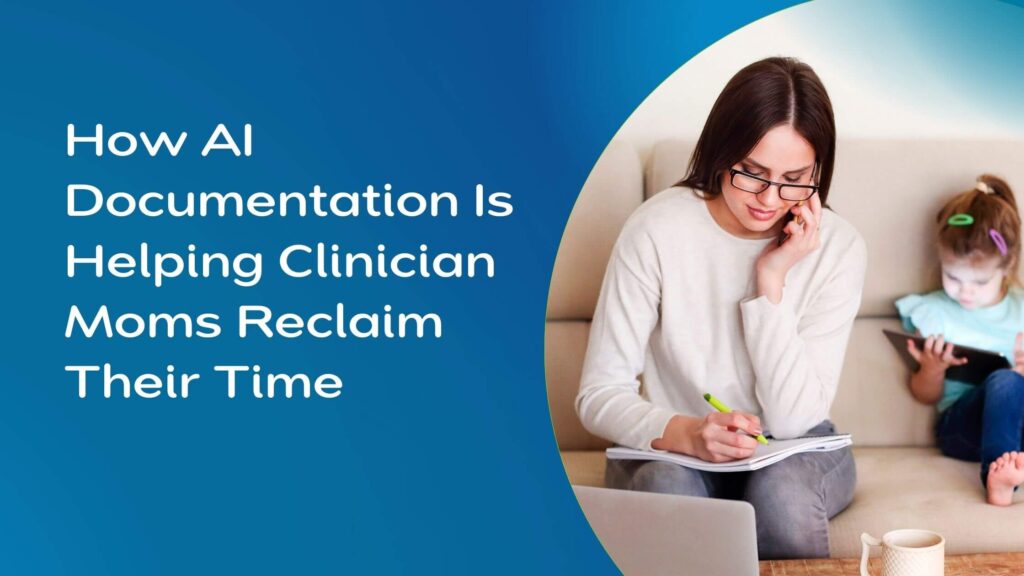
For many clinicians, the workday doesn’t end when the last patient leaves. Instead, it often continues at home — catching up on notes, finishing documentation, and carrying the mental weight of unfinished work into family time.
For working moms in healthcare, that challenge can feel even heavier.
During a recent Clinical Conversations discussion, CORA Physical Therapy leaders sat down with Emily Elliott, PT, to talk honestly about documentation burden, work-life balance, and how AI technology is changing the day-to-day reality for clinician moms.
The takeaway was clear: AI documentation isn’t just a productivity tool — it’s a quality-of-life game changer.
The Reality of Documentation for Clinician Moms
If you’ve been practicing for a few years, you’ve likely felt it. You gain confidence as a clinician, your caseload grows, and the pace increases. However, documentation often lags behind.
Emily Elliott, a physical therapist and mom of two, described what this looked like early in her career:
- Finishing a full day of patient care
- Driving home and spending time with family
- Then sitting down late at night or arriving early the next morning to finish documentation
While this routine is common in outpatient care, it creates a constant tension between professional responsibility and personal life.
Why Documentation Burden Hits Moms Differently
There are only so many hours in a day. For clinician moms, time after work is often spoken for — dinner, homework, activities, and simply being present with their kids.
However, unfinished notes don’t disappear when you clock out. Instead, they linger.
That mental load can show up as stress during family time, guilt about unfinished work, and difficulty fully disconnecting from the clinic.
Once the workday ends, the second shift begins.
How AI Documentation Changes the Workday
This is where AI technology becomes transformative.
At CORA Physical Therapy, clinicians use Comprehend Health’s AI Medical Scribe to support real-time documentation during patient visits. Instead of typing notes after the fact, clinicians can complete documentation as part of the visit.
As a result, documentation happens during the workday, not after it.
Time Saved Adds Up — Daily, Weekly, Monthly
In outpatient settings, documentation time quietly accumulates. Even clinicians who are highly efficient often spend hours each week just catching up.
Clinicians using AI documentation report saving significant time regardless of patient volume, note type, or diagnosis complexity.
Importantly, this benefit applies even to clinicians who were initially skeptical about AI.
More Than Time Savings — It Frees Mental and Emotional Space
The impact of AI documentation goes beyond efficiency.
When notes are finished at work, mental clutter decreases, stress levels drop, and clinicians can fully transition into personal time.
Being done with documentation allows clinicians to truly be done with work.
Supporting the Full Lives of Clinicians
Work-life balance isn’t limited to parenting young children. Many clinicians are also supporting aging parents, managing households, and navigating full lives outside the clinic.
By reducing documentation burden, AI technology supports clinicians as whole people — not just providers.
Why This Matters for the Future of Physical Therapy
For clinicians exploring new opportunities, this distinction matters. Not every outpatient practice invests in technology that truly supports work-life balance.
As physical therapists increasingly seek jobs that allow them to finish work at work, employer commitment to tools like AI documentation becomes a meaningful differentiator.
For clinicians exploring their next step, work-life balance doesn’t have to be theoretical. At CORA Physical Therapy, we invest in technology that helps clinicians finish their workday at work — and be fully present after.
Frequently Asked Questions
Q: How does AI documentation support physical therapists?
AI documentation helps physical therapists complete notes during patient visits, reducing after-hours work and documentation-related stress.
Q: Does CORA offer AI documentation tools to clinicians?
Yes. CORA Physical Therapy uses AI medical scribe technology to support efficient, real-time documentation.
Q: Does CORA support work-life balance for clinician parents?
CORA invests in technology, flexibility, and resources designed to help clinicians balance professional and personal responsibilities.